

Our History
The History of Optimist International
The Beginnings
As industrialization and urbanization brought many new problems to society, citizens began forming voluntary organizations to address the needs of their communities. In some areas, groups took the name “optimist club” to express their desire for a positive outlook in the face of all these problems. The first official Optimist Club was formed in Buffalo, New York, in 1911.
Impetus for a nationwide Optimist movement began when the Optimist Club of Indianapolis, Indiana, was formed in May 1916. Envisioning a nationwide organization, founders of the Indianapolis club moved ahead in the summer of 1916 to start Optimist Clubs in many other major cities.
These clubs quickly grew to more than 100 members each. As a result, a national conference of the American clubs took place in 1917 in Indianapolis.
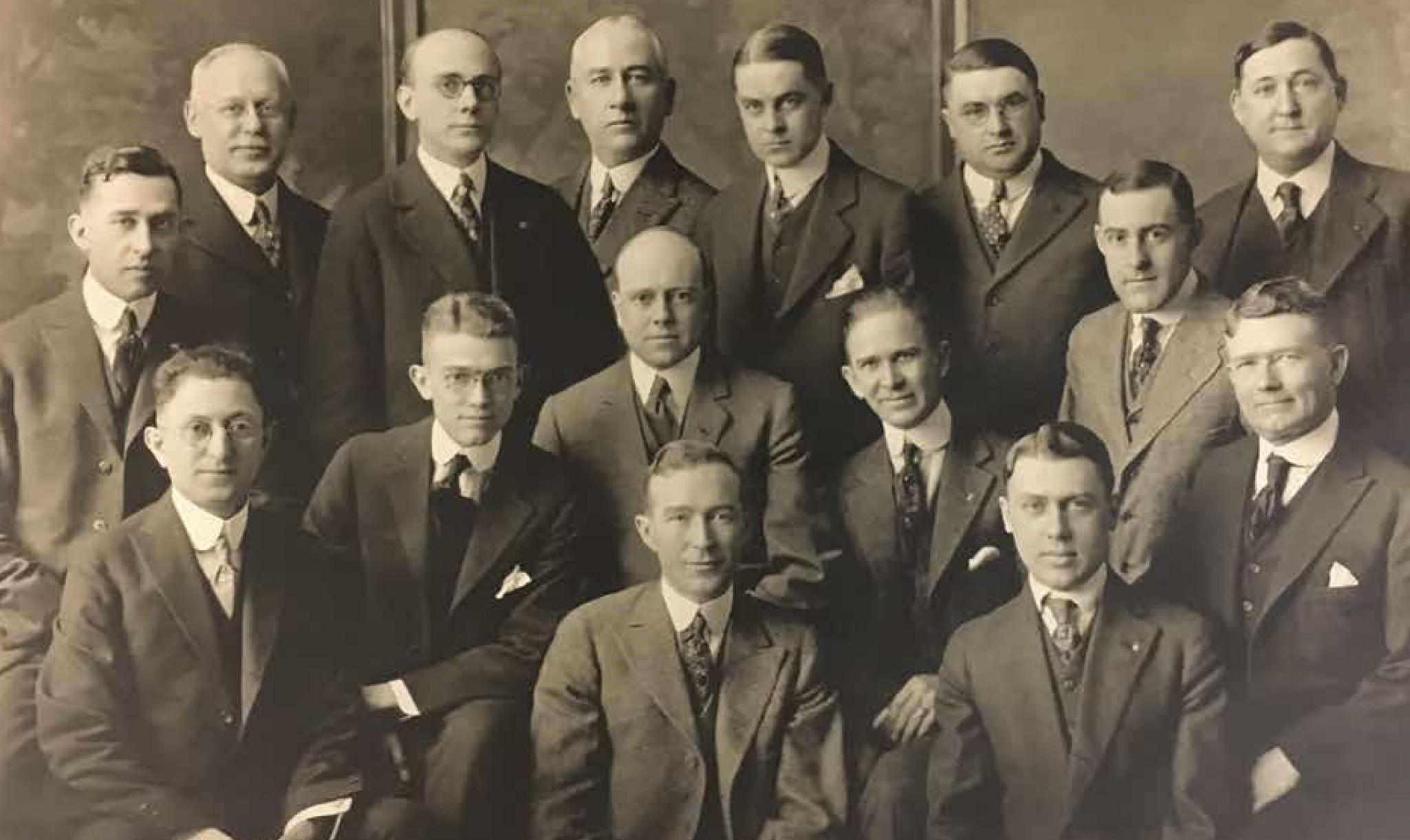
The original members of the Optimist Club of Indianapolis, 1916 Top row, from left: Charles Habig, James Trotter, W. T. Trotter, W. T. McCullough, Frank E. Gates, Edwin Quarles, Dr. J. W. Ricketts, Joseph Raub. Center row: Eli Schloss, Charles A. McKeand, Luman Babcock, R. L. Mellett, Sumner Clancy, A. W. McKeand Front row: Harlan Bosler, D. J. Crittenberger.
Christian D. Larson
Christian D. Larson publishes a 12-verse poem entitled “Promise Yourself” in his book, Your Forces and How to Use Them.
As the clouds of war loom over the world, business and professional leaders in Indianapolis foIndianaprm an Optimist Club. Unaware of the New York Optimist Clubs, the Indianapolis Optimists also start a national organization known as the American Optimists’ Clubs.
Within a few months, the new organization assists in starting Optimist Clubs in Louisville, St. Louis, Kansas City, Missouri, Denver, Milwaukee, Washington, D.C., and Springfield, Illinois.
25 New Optimist Clubs
Optimist Clubs start in Los Angeles, San Diego, Baltimore, Chicago, Minneapolis, St. Paul, St. Joseph, Kansas City, Kansas, Peoria, and several other cities. By the end of the year, there are 25 Optimist Clubs affiliated with the American Optimists’ Clubs.
Flu Pandemic
Optimist Clubs focus their efforts on raising funds for the war effort, supporting military families, and assisting families devastated by the Flu Pandemic.
Winifred Westervelt, the wife of Los Angeles Optimist James Westervelt, gives a 10-verse version of “Promise Yourself” to her husband who publishes it in the Club’s yearbook. The Los Angeles Optimists adopt it as their Creed and share it with other Optimist Clubs in California.
The Founding of Optimist International
Times were good. World War I had been fought and won and spirits were high in America. It was an ideal time for the birth of Optimism. The association of clubs that is known today as Optimist International was formed on June 19, 1919, when representatives of 11 clubs held a convention in Louisville, Kentucky, and adopted the name International Optimist Club. During the convention, William Henry Harrison, a descendent of the ninth president of the United States bearing the same name, was elected the first International President of Optimist international.
Over the next three years, the organization grew to 49 clubs and 4,000 members.
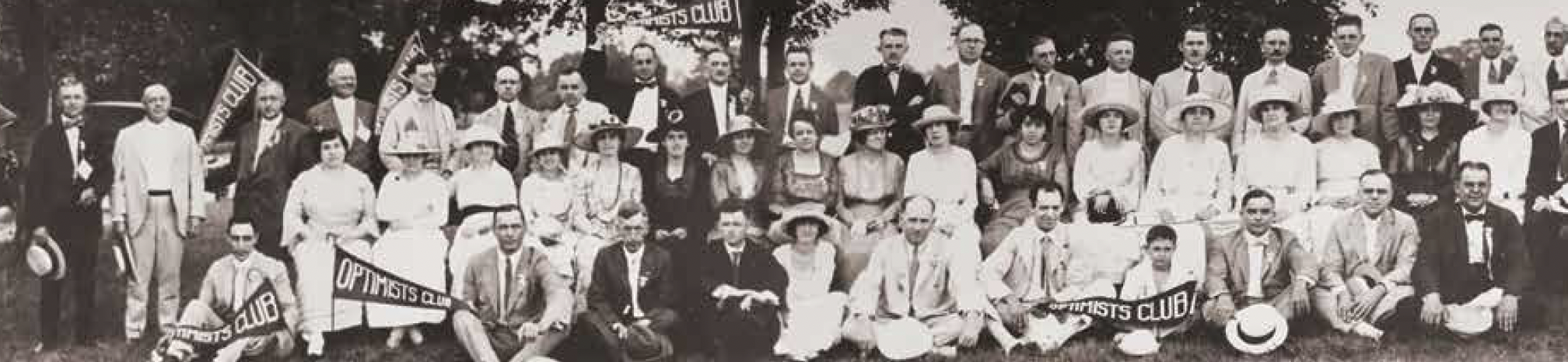
A Full Fledged Organization is Formed
In October 1920, the first edition of The Optimist magazine was published. Each of the 27 clubs was asked to report in at least once a month with news of their club.
Optimist Creed
In 1922, the Optimist Creed was adopted as the official creed of the organization. Written by Christian Larson, the creed was originally published under the title “Promise Yourself” in 1912. Optimists in California found the Optimist spirit well-expressed in the 10-line statement and pushed to have it adopted organization-wide. The wife of Los Angeles Optimist James V. Westervelt saw the item in a newspaper and clipped it for her husband. After publishing it in his club's bulletin, Westervelt and other Los Angeles Optimists encouraged other California clubs to use the creed. Soon after, the creed's popularity grew.
Official Emblem Developed
In August 1922, the first official emblem of Optimist International was developed and adopted. The emblem consisted of a youngster with a beaming countenance and the words “International Optimist Club.” Along with the smiling face appeared another symbol. It had a sun in its center and the words “Friendship, Sociability, Loyalty, Reciprocity” around it as a border. The emblem can be found on page 35 in Of Dreams and Deeds.

Motto “Friend of the Delinquent Boy”
From the beginning, Optimist Clubs directed major efforts toward youth service. As a result, in 1923, the motto “Friend of the Delinquent Boy” was chosen, setting the course of the organization. The motto was introduced by Dr. Hartloft, a medical examiner in Evansville, Indiana, who became a community leader when he served as past president of the Big Brother movement.
Motto review to "Friend of Boy"
In 1924, it was voted by the convention delegates that the Optimist International motto be revised to “Friend of the Boy.”
Junior Optimist Clubs
In 1924, the first organization-wide youth service program was established with the chartering of Junior Optimist Clubs. Its purpose was to instill the value of volunteering in young boys. The idea of creating youth clubs was developed in 1920 by Milwaukee Optimist Henry Scarborough, who was well-known in his community in vocational guidance and personnel relations. After gathering a group of young boys together, they agreed that since the Optimists served as the group’s sponsor, they should call themselves “Junior Optimists.”
42 Junior Optimist Clubs formed
During the 1924 convention in Milwaukee, the Junior Optimist Club idea really began to spread. The delegates voted the right of Optimist International to charter Junior Optimist Clubs everywhere, with an Optimist Club as its sponsor. The idea spread like wildfire and right before World War II, there were 42 Junior Optimist Clubs formed with several hundred youth members.
Optimist Club of Toronto, Ontario
Also in 1924, history wa1ss made when the Optimist Club of Toronto, Ontario, was formed, the first club outside the United States. Four months later, the second Canadian Optimist Club was chartered in Hamilton, about 40 miles west of Toronto.
Oratorical Contest
In 1928, an organization-wide Oratorical Contest was started for the Junior Optimist Clubs. Through the years, its purpose has been to provide a valuable self-improvement activity and scholarship program for youth. Today, this remains the oldest and most well-known program of Optimist International.
Executive Director - Russell Meyer
117 clubs & 8,000 members
In 1929, the organization grew to 117 Optimist Clubs and 8,000 members.
The stock market crashes and so began the Great Depression. Optimists immediately recognized the much-needed philosophies of Optimism.
Meeting the Challenge
During the early 1930s, as a result of the Great Depression, membership dropped significantly. Despite the dropping numbers, Optimists continued to increase their youth service, tripling the number of youths reached. In fact, there were twice as many Junior Optimist Clubs in 1931 as there had been in 1929.
Optimist Clubs Join in Community Efforts
1933 As the Great Depression continues, Optimist Clubs step forward to help fellow Optimists and others to avoid foreclosure. In addition, Optimist Club join in community efforts to provide jobs for the unemployed and to fight polio.
Milestones
The first International Convention held outside the United States convenes at the Royal York Hotel in Toronto.
The Los Angeles Optimists adopted the Youth Home as a project in 1917. It was known as the Strickland Home for Boys and was still known as that when Optimists helped them organize as a 501(c)(3) in 1934. It became the Optimist Home for Boys in 1940.
“Life Membership”
The delegates at the International Convention in Fort Worth adopt the “Life Membership” initiative to help raise desperately needed funds for Optimist International to remain solvent. To receive a Life Membership in the international organization, members of Optimist Clubs pay a one-time fee of $100. The funds raised are designated for new club building.
First Canadian President of Optimist International
Delegates at the International Convention in Cincinnati, Ohio, elect William J. Tamblyn of Toronto as the first Canadian to serve as President of Optimist International.
In November, Optimist Clubs distribute 5,000 copies of The Optimist Creed during “International Optimist Week.”
Canada Enters World War II
In September, Canada enters World War II. On the first day of the war, Dr. Frank H. Fish of the Optimist Club of Calgary, Alberta, enlists in the Royal Canadian Army. He is the first of more than 2,000 Optimists in Canada and the United States to serve in the military during the war.
Pilot Officer Gordon McKenzie Stewart, a member of the Optimist Club of Stratford, Ontario, is shot down over the beaches of Dunkirk,
France. He is the first Optimist killed in action during World War II.
The Pan American Optimist Club of El Paso, Texas and Juarez, Mexico is formed to promote friendly relations between the two communities.
The Optimist Club of St. Catharines, Ontario, establishes the No. 23 Royal Canadian Optimist Air Cadet Squadron. Soon, Optimist Clubs throughout Canada begin sponsoring Cadet Squadrons to support the war effort.
"Chocolate Fund" & Essay Contest
The Optimist Club of Welland, Ontario, creates the “Optimist Chocolate Fund” to raise money for the distribution of chocolate bars to British children. By the end of World War II, Optimists from Canada and the United States will send over more than 2 million candy bars to the children of Great Britain.
The Optimist Club of Quebec City becomes the first club known to conduct its business meetings in French.
Optimist International sponsors an Essay Contest for male and female high school students. The subject of the inaugural Essay Contest is “Youth’s Interest in Democracy.”
Following the attack on Pearl Harbor, the United States enters World War II. Just six days later, the Optimist Club of San Juan, Puerto Rico receives its charter.
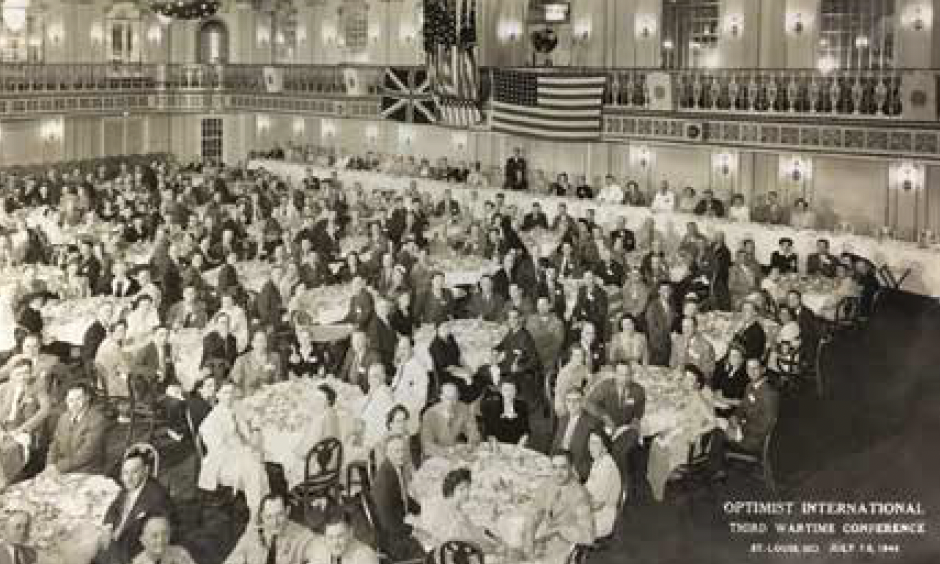
First Wartime Conference
Optimist International suspends new club building efforts until the end of the war after all the members of the field staff resign to enlist in military.
Due to travel restrictions, the First Conference is held in Chicago. These conferences would replace International Conventions until the end of the war.
War Bonds, Scrap, Metal and Rubber Drives
Optimist Clubs focus on supporting the war effort by selling war bonds, conducting drives to collect scrap metal and rubber, and sending packages to Optimists and their family members stationed overseas.
President Harry S. Truman Honorary Life Member
In recognition of his efforts in bringing an end to World War II, Optimist International awards President Harry S. Truman an honorary life membership. In a ceremony in the Oval Office, Truman reminds those in attendance that he was a member of the Optimist Club of Kansas City, Missouri before going to Washington.
Optimist International accepts President Truman’s invitation to send a consulting delegate to the United Nations Conference held in San Francisco. The Optimist Club of Monterrey, Mexico is formed. It is the first Optimist Club in which all of the members are citizens of Mexico.
Optimists United for Peace
Optimist International enters its first float – ”Optimists United for Peace” – in the Rose Bowl Parade in Pasadena, California.
The Chinatown Optimist Club of San Francisco is chartered to serve Asian youth. International President Carl C. Donaugh presents Canadian Prime Minister Mackenzie King with an honorary life membership at his office in the House of Commons in Ottawa.
Sailing Regattas for Boys and Girls
Club de Optimistas de la Habana-Cuba receives its charter. Two additional Optimist Clubs are started in Cuba prior to the revolution.
Optimists Branch Rickey and A. B. “Happy” Chandler work together to integrate major league baseball as Jackie Robinson begins his career with the Brooklyn Dodgers.
Optimist Clark W. Mills designs the “Optimist Class Pram” for the Optimist Club of Clearwater, Florida to help introduce youth to sailing. Within five years, Optimist Clubs in the United States, Canada, and Cuba are sponsoring Optimist sailing regattas for boys and girls.
Boys' Work Fund
The Optimist International Boys’ Work Fund is formed to raise money for Optimist youth programs.
Opti-Mrs. member Gretchen Fraser of Vancouver, Washington becomes the first American to win an Olympic medal in skiing, receiving a gold medal in the slalom event and a silver medal in the alpine combined event, at the Winter Olympics in St. Moritz, Switzerland.
Launching New Programs
The first Optimist Club started in the new decade is organized in Indiana, Pennsylvania. Wanting to help the youth in his hometown, actor Jimmy Stewart becomes a charter member.
 (Jimmy Stewart becomes a charter member)
Comedian Bob Hope performs his radio show – followed by a vaudeville show – in Long Beach, California to benefit the Optimist Home for Boys in Los Angeles.
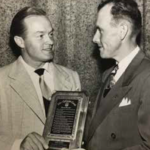 (Bob Hope receives The Optimist Creed from Long Beach Optimist Club President Joe Blackburn in California in 1950.)
The 1950s were also a time in which Optimists recognized that there were kids who needed their help. In San Antonio, a young clergyman called the attention of his Optimist Club to the homeless and neglected boys sleeping under bridges and on the streets. This led to the start of many boys’ homes throughout the country. Some of the more famous optimist-sponsored boys’ homes were the Optimist Home for Boys in Los Angeles and Boysville in San Antonio.
Achievement & Awards Program and Safe Rider on. Safe Bikes
1951 The creation of the “Achievement and Awards Program” helps recognize individuals, Clubs, Zones and Districts for their efforts in growing the organization.
1952 International President Roly P. Nall presents an honorary life membership to Canadian Prime Minister Louis Stephen St. Laurent.
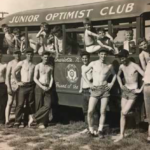 (In 1952, The Junior Optimist Club of Charlotte, North Carolina, had its own bus for taking the boys on swimming trips, to athletic trips, to picnics, and other community and Club activities.)
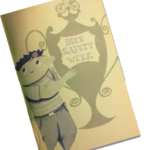
1953 Using the motto “Safe Riders on Safe Bikes,” Optimist International sponsors the first International “Bike SafetyWeek".
President Dwight D. Eisenhower
For the first time, every District enters a contestant in the finals of the Oratorical Contest held at the International Convention in Washington, D.C. President Dwight D. Eisenhower invites the contest winner, Daniel T. Yates, to meet with him in the Oval Office.
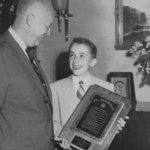 (U.S. President Dwight D. Eisenhower greets Optimist Oratorical contest winner Daniel T. Yates in 1953.)
1,000 Club Organized
1954 The Japanese American Optimist Club of Los Angeles is organized to help the youth in the community.
The Optimist Club of Neenah-Menasha, Wisconsin becomes the 1,000th club in Optimist International.
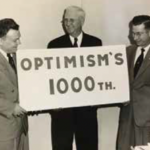 (From left) Neenah-Menasha Optimist Club President Earl G. Smith, International Director of Wisconsin Melvin C. Reppen, and Oshkosh Optimist Club President Earl King in 1954.)
International Convention held in Quebec
The first International Convention held in Quebec convenes at the Sheraton-Mount Royal Hotel in Montreal.
Youth Appreciation Week
The first annual Optimist International Youth Appreciation Week is held in November.
Actor Robert Young stars in a 15-minute film in honor of Youth Appreciation Week, which is shown by television stations and in schools throughout North America.
Dick Clark
The host of American Bandstand and The Dick Clark Show – records a 15-minute radio program for Youth Appreciation Week that is broadcast in the United States, Canada, and several other nations.
A Decade of Great Expansion
1960 A campaign begins to fight child pornography and to prevent all forms of pornography from reaching school-age children.
"A Boy Today– a Man Tomorrow"
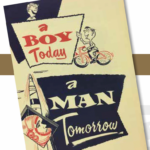
1961 Optimist International publishes a booklet called "A Boy Today – a Man Tomorrow" to give “accurate answers to questions boys have about the facts of life...” By the 1990s, more than a million copies of the booklet would be distributed to schools and youth organizations around the world.
Optimist NEW Home
Optimist International moves into its new home located in the Central West End of St. Louis.
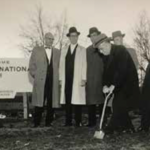 (Breaking ground at the new Optimist International headquarters, St. Louis, Missouri.)
The following month, the Board of Directors holds its first meeting in the new building.
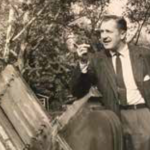 (Actor Vincent Price visits the site of the future Optimist International headquarters. 4494 Lindell Avenue used to be the home of the Mesker family where Price used to visit for parties. He called the new development “sensational.”}
The 2,000th Optimist Club is organized.
Octagon Clubs
Octagon Clubs for high school boys are introduced as an official part of the Junior Optimist program.
The delegates at the International Convention in Toronto approve the creation of a Community Service Department to assist Clubs in better serving their local Junior communities.
"Stay in School" Program
The “Stay in School” program is launched to help reduce the number of high school dropouts.
For the first time, Districts are given geographical names instead of numbers.
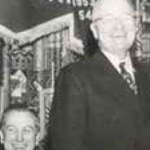 Former U.S. President Harry Truman speaks to his “home” club in the 1950s. Truman was a member of the Optimist Club of Kansas City, Missouri prior to moving to Washington, D.C.
"Respect for Law"
"At the International Convention in New Orleans, Optimist International launches the “Respect for Law” program in cooperation with the Federal Bureau of Investigation and the Royal Canadian Mounted Police.
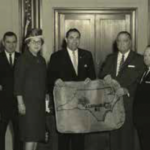 (1964-65 International President Carl Bowen presents FBI Director J. Edgar Hoover with a souvenir mat. Optimist International worked with Hoover to develop the Respect for Law Program.)
'Dreams and Deeds' Published
The book Of Dreams and Deeds – written by Gordon “Bish” Thompson – is published.
Tournament of Roses Parad Winner
Optimist International sponsors a float in the Tournament of Roses Parade and wins the Judges Special Award for Humor.
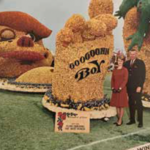
Optimist International starts “Project RSVP” – Register, Study, Vote, and Participate – to stimulate “public interest, faith, and participation in government.”
Delegates at the International Convention in Louisville change the beginning of the fiscal year from July 1 to October 1. As a result, the 1968-69 officers serve 15-month terms.
Optimist International Foundation
More than 3,000 Optimists and family members attend the 50th anniversary celebration of Optimist International at the International Convention in Miami Beach, Florida.
The Board of Directors creates the Optimist International Foundation.
Rapid Growth
Optimist International begins the “Drug Abuse Information Program” in cooperation with the American Medical Association, outlining steps that Clubs can take to help prevent drug abuse in their local communities.
Change, Growth, and Adding New Programs
At the Optimist International Convention in Minneapolis, Minnesota, it was announced that the International Board had approved the Optimist International Foundation and that all necessary legal steps had been taken to put it into business. The purpose of the Foundation is to operate exclusively for the charitable, literary or educational purposes of Optimist International.
The Oratorical Contest is expanded to include contests for both boys and girls.
At the International Convention in Minneapolis, the Tri-Star Basketball program is launched. Due to the success of the basketball skills competition, other sports are added to the Tri-Star program over the years.
Optimist Earl Yarborough – who had originated the idea for an Optimist Youth Appreciation Week – and International President Charles C. Campbell attend a ceremony in the Oval Office in which President Richard M. Nixon signs a proclamation recognizing Youth Appreciation Week in the United States.
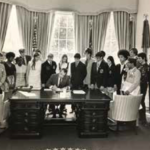 U.S. President Richard M. Nixon signs the Youth Appreciation Week proclamation in 1971
"Friend of Youth" | Girls admitted to JOI
The delegates at the International Convention in Montreal adopt “Friend of Youth” as the organization’s new official slogan to recognize the service performed by Optimist members for all youth.
In an attempt to address environmental concerns, a new program called “Living is for Everything” or L.I.F.E. is launched to help local communities to reduce air, water, noise, and other types of pollution.
Girls are officially admitted into membership of Junior Optimist Clubs.
New Optimist Welcome (NOW)
The “Adopt a Neighborhood” program is created to strengthen urban communities.
The very successful New Optimists Welcome (NOW) program is introduced to help existing Optimist Clubs add new members.
Growth of Optimist Movement
The Los Angeles Times notes the continued growth of the Optimist movement at a time when other service clubs are reporting a decline in membership.
The Quebec-Maritime District opens an office in Montreal to provide service to its members.
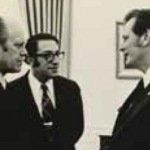 In 1975, U.S. President Gerald R. Ford, an Optimist Member, greets 1974-75 International President Ralph Glasscock.
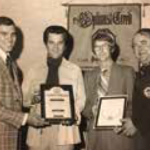 In 1975, Singer Conway Twitty (second from left) is presented with a new Member award by the Southside Oklahoma Optimist Club.
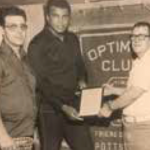 In 1976, professional boxer Muhammad Ali (center) is presented with The Optimist Creed by the Optimist Club of Pottsville.
Optimist Junior Golf Tournament | Communication Contest for Deaf and Hard of Hearing
A new three-level addition to the Optimist International headquarters is dedicated.
The “Help Them Hear” program is introduced to assist Optimist Clubs in serving young people with hearing impairments. The success of the program leads to the Communication Contest for the Deaf and Hard of Hearing.
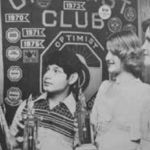 (1978 Communication Contest for the Deaf and Hard of Hearing winners are presented with trophies.)
Optimist International becomes a sponsor of Junior World Golf and the first “Optimist Junior World Golf Tournament” is held in San Diego. Hugh Cranford is instrumental in starting the Optimist Junior Golf program. Today, in recognition of his efforts, the Hugh Cranford All-Scholastic Team is selected each year to recognize the academic and community service accomplishments of select junior golfers.
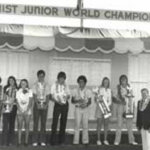 Leaderboard at the 1978 Optimist Junior World Championship. Right: International President Dudley Williams with winners of the 11th annual Optimist Junior World Golf Championships at Torrey Pines South in San Diego.
First African-American Governors
Former Major League Baseball player Sherman J. Jones of the Kansas District and Roddy L. Couts of the New Jersey Lower New York District become the first African-American Governors in the history of Optimist International.
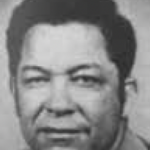 Samuel Jones
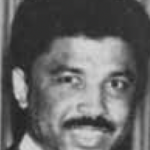 Roddy Couts
A Time of Change
The Optimist Club of Kingston, Jamaica, is chartered, bringing the Optimist movement to the English-speaking Caribbean.
Lionel Grenier becomes the first Optimist International President from Quebec.
Sherman Jones becomes the first African-American International Vice President and member of the International Board of Directors.
Optimist International begins managing the Canadian Service Center inMontreal, Quebec.
Winner of 1st Essay Contest
Caroline Labbe, of St. Georges Ouest, Quebec, wins the first Optimist International Essay Contest held since World War II.
Just Say "NO"
Optimist International endorses the “Just Say No” program to educate youth on the dangers of substance abuse. Optimists introduce a chicken mascot named “Mr. Resister” to encourage younger children to stay away from drugs and alcohol.
OIF $2 Million
Optimist International Foundation reaches $2 million in assets.
OI Meets President Ronald Reagan
International President James E. “Jay” Attarian meets with President Ronald Reagan and First Lady Nancy Reagan for a briefing on the “Just Say No” program.
Women admitted as Members
The Optimist International Board of Directors votes to admit women as members and the decision is ratified by 2/3 of the delegates at the International Convention in Montreal. Within a year, more than 6,000 women join Optimist Clubs.
Junior Optimists Hold First International Convention
Junior Optimists and their advisors gather for their first International Convention in Valley Forge, Pennsylvania, and form Junior Optimist Octagon International (JOOI). Adriana Johnson of San Antonio, Texas, is elected to serve as the first President of JOOI.
The Torch Magazine
JOOI decides to publish a quarterly magazine, the Forum VIII, the official publication for young Optimists. It will be renamed to The Torch in 1993.
Ruby Blair
Ruby Blair becomes Administrator of JOOI. In 1990, she is promoted to Director of Youth Clubs. She is credited for organizing the first Junior Optimist Convention, the creation of The Torch newsletter, and leadership training for Junior Optimists. Today, the Ruby Blair Award is given annually in her honor to an outstanding JOI member.
Canadian Children's Foundation
The Optimist International Foundation of Canada – now known as the Canadian Children’s Optimist Foundation – forms as a vehicle for Canadian members and others to make tax-deductible contributions to support Optimist youth programs.
340 New Club Built
During the administration of International President Ken Monschein, a record 340 new clubs are built in the North America, the Caribbean, and Europe.
1st Women to Serve as Governor
Jewel Thompson of the North Texas District becomes the first woman to serve as a Governor of Optimist International
Optimists in Action Day
The first “Optimists in Action Day” unites 232 Optimist Clubs and volunteers in a single day devoted to community service.
The Jamaica Optimist District is established. In addition, new Optimist Clubs are started in Bridgetown, Barbados and St. John’s, Antigua.
Optimist International took a step further in its substance abuse efforts by introducing the “get real!” anti-steroid program
Alpha Clubs
Alpha Clubs for students in first through fourth grades become an official part of JOOI.
In July, more than 300 JOOI members and their advisers attended the first organization-wide International JOOI Convention in Louisville, Kentucky.
Personal Growth & Involvement
The Personal Growth and Involvement Program--better know as PGI – was introduced.
The Optimist International Junior Golf Championships (OIJGC) are held in Miami, Florida.
The Optimist movement expands to the Pacific Rim with the chartering of the first Optimist Club in the Philippines. Within a year, Optimist Clubs are chartered in Taiwan and Hong Kong.
The first “Optimist Non Violence Day” is observed to educate youth and their parents about the dangers of violence and abuse.
A new “Safety on Wheels” program rolls out, expanding the bike-safety program to include inline skating, skateboarding and similar activities.
Always Buckle Children in the Back Seat
The Optimist International Junior Golf Championships finds a new home at PGA National Resort in Palm Beach Gardens, Florida.
Optimist International introduces the “Always Buckle Children In the Back Seat” (ABC) program and Optimist Clubs begin distributing car seats as well as educational
pamphlets to new parents.
The Caribbean District is established with Clubs in Anguilla, Antigua and Barbuda,
Barbados, Grand Cayman, Dominica, Jamaica, Montserrat, St. Kitts, St. Lucia, and
Trinidad and Tobago.
The Optimist International Junior Golf Championships receive global recognition when the tournament is televised on ESPN.
Virginia Ricker of the South Carolina District becomes the first woman to become an International Vice President and a member of the International Board of Directors.
At the 109th Tournament of Roses Parade, the Optimist International float – “Your Own Backyard” – wins the National Trophy for best depiction of life. Riding on the Optimist float is Eddie Robinson, the legendary head football coach at Grambling State University.
Optimists from around the globe gather at the International Convention in Toronto to celebrate 75 years of Optimism in Canada. Malcolm “Mac” McDonald publishes his book, Our Youth, Our Future, Celebrating 75 Years of Optimism in Ontario.
Childhood Cancer Campaign
The Optimist program to fight Childhood Cancer is adopted to assist children with cancer and their families. Optimist International initiated the program while the Optimist International Foundation provides funding.
To honor the first President of Optimist International, the Optimist International Foundation and the Canadian Children’s Optimist Foundation establish the William H. Harrison Society.
International President Robert Garner meets with President George W. Bush and other community service leaders to discuss the mentoring of youth.
Optimist International Entry WINS Trophy
The Optimist International entry in the Rose Parade – “Sweet Dreams” – wins the Tournament Volunteers’ Trophy for best floral design in its class.
Collaboration with Johns Hopkins University
As part of the Childhood Cancer Campaign, Optimist International collaborates with Johns Hopkins University to create an Optimist International Fellowship in Pediatric Hematology and Oncology.
Friends of Optimists
Delegates at the International Convention in Nashville approve a new class of membership – known as the “Friend of Optimists” – to allow individuals to support the organization’s mission even if they are unable to join a local Optimist Club.
The inaugural Optimist International “Tournament of Champions” – an invitational event featuring the top finishers from premiere junior golf tournaments – is held in Miami, Florida.
Ronnie Dunn of Frankfurt, Kentucky, becomes the first female President of Optimist International.
Junior Optimists introduce the “JOOI of Reading” literacy program to encourage young children to discover the importance of reading, and to encourage youth clubs to participate in literacy projects for children.
Theo Golding of Kingston, Jamaica, becomes the first International President from outside the United States and Canada.
Internet Safety
The Internet Safety program is unveiled to provide Optimist Clubs with resources to educate both youth and their parents about potential dangers of online predators.
Nearly a dozen Parallel District Conferences are presented at various locations across North America.
$30 Under 30
The “$30 under 30” pilot program is adopted by the Board of Directors to encourage younger members to join Optimist Clubs.
Since that time, the program has been adopted as an official program and more than 8,000 members under the age of 30 years of age have been recruited into local Clubs.
The National Assembly of Quebec unanimously adopts a motion to proclaim the first Thursday of February as “Optimist Day” in recognition of the service provided by Optimist members to youth and community.
Karen Monville of Bay City, Michigan, becomes the first female to serve as President of the Optimist International Foundation.
The Optimist Charter School – designed to serve 100 youth on probation or in foster care – opens in Los Angeles.
Javanni Waugh from Kingston, Jamaica, is elected as the first person from the Caribbean District to serve as International President of JOOI.
The Optimist International Board of Directors recognizes the first Thursday in February as “Optimist Day” and the month of May as “Optimists in Action” month.
David Bruns, from Topeka, Kansas, is elected 2015-16 International President in the first Online Election held by Optimist International.
Presidents of the two Optimist Foundations become advisory members of Optimist International Board of Directors.
The Optimist Club of Bay City, Michigan, becomes the winner of the inaugural Optimist Club of the Year Award.
“By providing hope and positive vision, Optimist bring out the best in youth, our communities and ourselves” is adopted as the new Mission Statement of Optimist International.
The first Optimist International Oratorical World Championships take place at Saint Louis University.
Cameron Tyler of Jackson, Missouri, is crowned as the initial World Champion.
Delegates at International Convention in Quebec City approve a request from the JOOI members to change their name to “Junior Optimist International” (JOI).
Optimist Clubs in Thailand, Morocco, Senegal and Mali join the Optimist family.
Nina Strickland of Corunna, Ontario, becomes the first female President of the Canadian Children’s Optimist Foundation.
The first Club in the Federal Democratic Republic of Nepal is organized in Kathmandu.
Over the next two years, six additional Optimist Clubs will be started in Nepal.
The Board of Directors approves the Club-Within-a-Club program.
Optimist International introduces an updated logo and official branding guidelines.
After the devastation of Hurricane Harvey and Irma, Optimist International Foundation creates the Disaster Relief Fund.
President Nick Prillaman and
2018-19 President Rebecca Butler Mona jointly kick-off the Optimist International Centennial celebration at the Optimist International Convention in Ottawa, Canada.
Optimist International unveils new “Childhood Health and Wellness” initiative to assist youth and families.
Maria Giorlando, a member of the Optimist Club of St. Clair Beach, Ontario, is crowned as Miss Canada and selects the Optimist movement as her cause to promote as she travels across the nation.
Optimist Clubs are chartered in Beijing and in the Guangdong Province, China.
The chartering of the Optimist Club of Montevideo, Uruguay brings Optimism to South America. Past International President David Bruns authors the book, “Bringing Out the Best” – The First Century of Optimist International (1919-2019).